
Moving to Dubai in 2026: Why Month One Is the Most Expensive
- •
- 8 min
- •
- RSS

Forward Deployed Engineer · Dubai
There's a number that shocks almost every newcomer to Dubai. Not the rent — people expect that to be high. Not the summer electricity bill — they've heard about that too. It's the total amount they need to spend before they even sleep their first night in their new apartment.
We're talking about the first-month number. The sum of every deposit, fee, commission, and payment that lands between signing a lease and turning on the lights. For a single professional renting a modest one-bedroom in JVC, that number is often AED 30,000–50,000. For a family in a three-bedroom in Dubai Hills, it can exceed AED 150,000 — and that's before furniture.
The problem isn't that these costs are unreasonable. Most are standard and well-documented if you know where to look. The problem is that nobody presents them as a single, consolidated number. You discover them one at a time, each one a small surprise, until the total becomes a big one.
This analysis is based on 2026 Dubai market rates, conversations with recent movers, and data from property platforms and government fee schedules. For a personalized estimate based on your situation, try the free Dubai Budget Planner.
The wall of day-one costs
Here's what happens in a typical move-in scenario. You've found an apartment, agreed on the rent, and you're ready to sign. Between that moment and the moment you're actually living there, here's what you'll pay:
1. Rent cheques — the biggest single hit
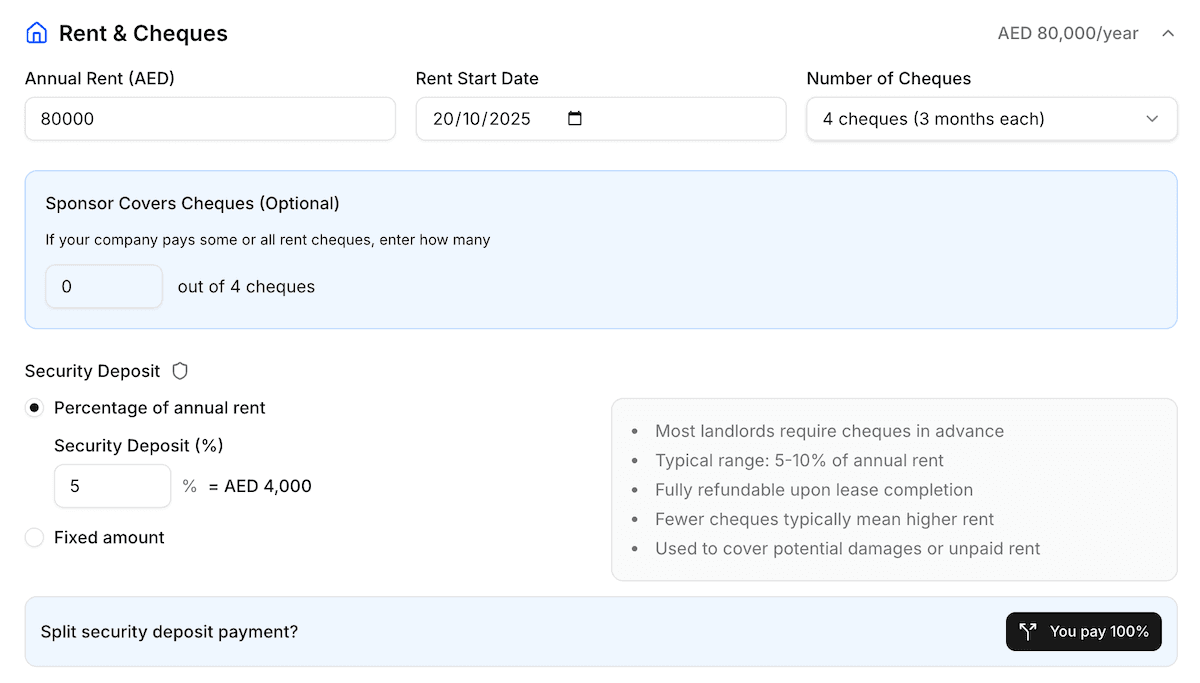
Dubai landlords don't collect rent monthly. They collect it in advance, via post-dated cheques — typically 1, 2, 4, or 6 cheques per year. The fewer cheques you negotiate, the lower the total annual rent tends to be, but the larger each individual payment.
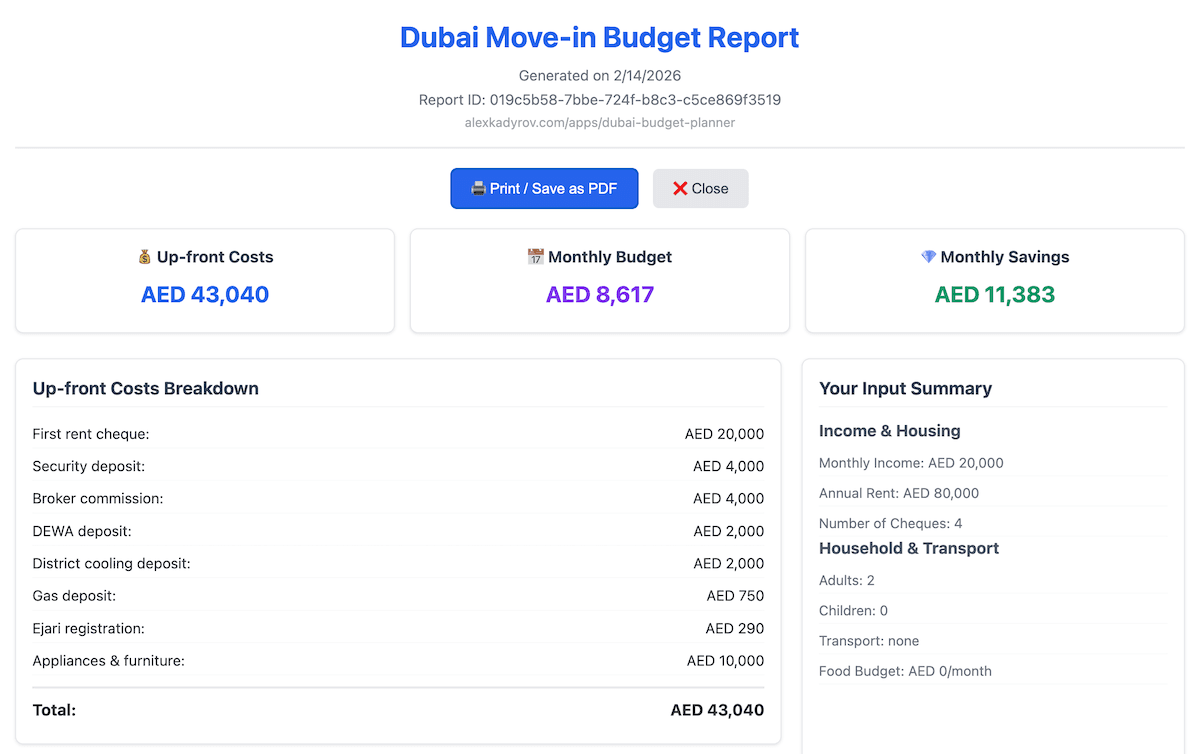
If your annual rent is AED 80,000 and you're paying in 4 cheques, your first cheque is AED 20,000 — due on the day you sign. That's not a deposit. That's your first quarter's rent, gone before you've moved a single box.
2. Security deposit
Landlords typically require 5% of the annual rent as a refundable security deposit for unfurnished properties, 10% for furnished ones. On an unfurnished AED 80,000 apartment, that's AED 4,000 upfront.
The good news: you get this back when you leave, assuming normal wear and tear. The bad news: it's still cash you need on day one.
3. Broker commission
If you used a real estate agent (and most newcomers do), you'll pay a commission — typically 5% of the annual rent. On an AED 80,000 lease, that's AED 4,000.
Some agents charge a flat fee. Some negotiate. But the industry standard is 5%, and it's due when you sign.
4. Ejari registration
Ejari is the government system that officially registers your tenancy contract. Without it, you can't set up DEWA (electricity and water), get a residential parking permit, or sponsor family members.
The fee is around AED 250–300 for online registration. Small in isolation, but it's one more line item on an already long list.
5. DEWA deposit and connection
DEWA (Dubai Electricity and Water Authority) requires a refundable deposit before they'll connect your apartment: AED 2,000 for apartments, AED 4,000 for villas. There's also a connection fee of around AED 130.
This catches people off guard because in most countries, you just call the utility company and they turn it on. In Dubai, you're putting down two thousand dirhams before you've used a single kilowatt.
6. District cooling deposit
If your building uses centralized air conditioning (common in newer developments like Dubai Marina, JLT, Downtown, and Business Bay), you'll pay a separate deposit to the district cooling provider — typically AED 2,000–3,000.
This is on top of your DEWA deposit. Many newcomers don't realize their building has district cooling until they try to set it up.
7. Internet setup
Du or Etisalat home internet plans typically cost AED 270–400 per month, and some require installation fees or router deposits. Budget AED 300–400 for the first month including setup.
The costs nobody warns you about
Beyond the obvious fees, there are several expenses that consistently surprise newcomers:
The housing fee
Every tenant in Dubai pays a Municipality Housing Fee — 5% of the annual rent, divided into 12 monthly installments and added to your DEWA bill. On an AED 80,000 apartment, that's AED 4,000 per year, or about AED 333 per month appearing on your electricity bill.
People see their first DEWA bill and wonder why electricity costs AED 900 when they expected AED 600. The housing fee is why.
The knowledge fee and innovation fee
These are small surcharges added to your DEWA bill — typically AED 10–20 combined. Individually insignificant, but they contribute to that first-bill shock when your "utilities" cost more than you budgeted.
Appliances and furniture
If you've rented an unfurnished apartment (which is significantly cheaper annually), you'll need to furnish it. Even a minimal setup — refrigerator, washing machine, bed, and a basic sofa — runs AED 8,000–15,000.
Most newcomers underestimate this because they're used to furnished rentals or bringing furniture from their previous home. International shipping is expensive, so most people buy new in Dubai.
Moving services
Getting your belongings from the airport or a temporary stay to your new apartment isn't free. Local moving services in Dubai typically charge AED 500–2,000 depending on the volume and distance.
Why people get blindsided
The core issue isn't that these costs are hidden. Most of them are well-documented on government websites, property portals, and expat forums. The problem is structural:
Costs are discovered sequentially, not presented holistically. You learn about the broker fee when you meet the agent. You learn about DEWA when you register. You learn about district cooling when you call the provider. You learn about the housing fee when you get your first bill. Each cost appears reasonable in isolation, but nobody shows you the total before you commit.
Online "cost of living" calculators focus on monthly expenses. Numbeo, Expatistan, and similar tools estimate your monthly burn rate. They don't calculate the cash you need to have in your bank account on day one. The gap between "I can afford AED 6,000/month in rent" and "I need AED 40,000 in cash before I move in" catches people off guard.
Advice is fragmented. You read one blog post about Ejari, another about DEWA, another about broker fees. Nobody connects them into a single financial picture tied to your specific situation — your salary, your family size, your chosen area.
Planning for month one
Here's how people who move smoothly actually prepare:
1. Calculate your total up-front number first
Before you even start apartment hunting, estimate the total cash you'll need. A rough formula:
- First rent cheque (annual rent / number of cheques)
- Security deposit (5% of annual rent)
- Broker fee (5% of annual rent)
- DEWA deposit (AED 2,000)
- District cooling deposit (AED 2,000, if applicable)
- Ejari (AED 300)
- Internet setup (AED 350)
- Appliances and furniture (if unfurnished)
- Moving costs
Add these up before you commit to a rent level. Many people discover they can afford the monthly rent but not the move-in costs, and end up either borrowing or choosing a cheaper apartment than planned.
2. Negotiate the number of cheques
Fewer cheques typically mean lower total annual rent — landlords prefer fewer transactions. But fewer cheques also mean larger individual payments. If you're paying in 1 cheque, you need the entire year's rent upfront. Four cheques is the most common balance between cost savings and cash flow management.
3. Budget for the housing fee separately
Don't lump the housing fee into your "utilities" budget. It's a fixed 5% of your annual rent, and unlike electricity, it doesn't vary with usage. Treat it as a separate line item so your utility budget reflects actual consumption.
4. Know which deposits are refundable
DEWA deposit, district cooling deposit, and security deposit are all refundable when you leave. This matters for your financial planning — it's not money spent, it's money locked up. Budget for it, but know you'll get it back.
5. Use a calculator that shows the full picture
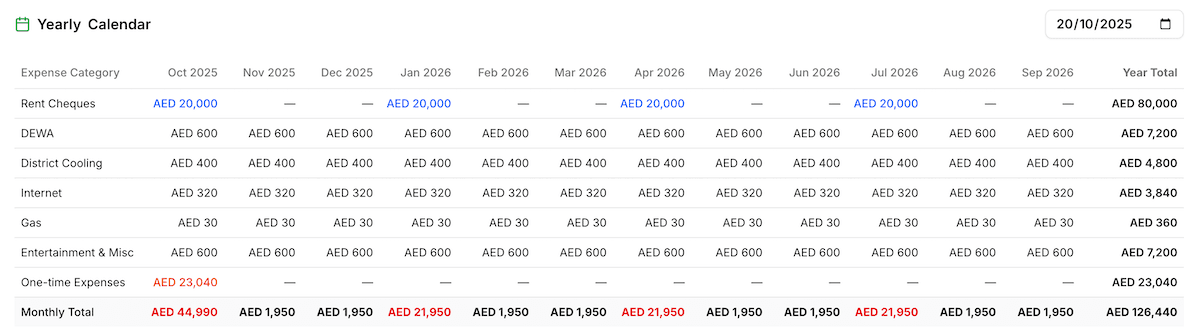
This is exactly why we built the Dubai Budget Planner. It calculates every up-front cost, every monthly recurring expense, and shows a 12-month calendar so you can see when your large payments fall due. You can pick a template that matches your situation — single professional, couple, or family — and get a realistic total in minutes.
The number you actually need
Here's the reality that surprises most newcomers: the amount of cash you need to have available for moving to Dubai is typically 3–6 months of your planned monthly expenses, concentrated into a single payment window.
For a single professional earning AED 15,000/month, the first-month cost is often AED 35,000–50,000. For a family of four earning AED 30,000/month, it can reach AED 100,000–150,000. These aren't outrageous numbers relative to the salaries being earned, but they require planning and savings that many people don't account for until it's too late.
The tax-free salary is real. The opportunity is real. But the entry cost is also real, and the people who move successfully are the ones who calculate it before they pack.
Want to see your specific number? The Dubai Budget Planner calculates your personalized up-front costs, monthly budget, and yearly cash flow — free, no signup required.