
I Built Tiny Apps for Fun. They Turned Into Weeks of Content.
- •
- 7 min
- •
- RSS

Forward Deployed Engineer · Dubai
For two weeks I posted variations of the same idea: stop overthinking your posts, hit Publish, let people decide whether your writing is any good. Same message, new wording, every day. It did fine. Nobody's life changed, including mine.
Then I spent two hours building it instead of saying it.
The result is Post or No — a tiny app where you paste the post you're scared to publish, watch a very confident algorithm pretend to analyze it for four seconds, and get told to ship it. About 88% of the time the verdict is POST. The "analysis" is theater. The confidence percentage is invented on the spot. It is the exact thing I'd been posting for two weeks, except now you can use it, and sometimes a friendly punch in app form lands harder than a paragraph of advice.
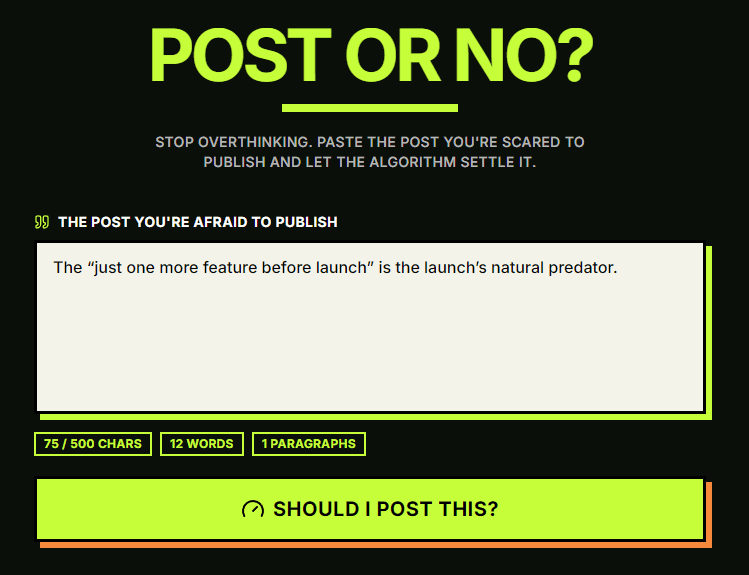
One thing it is not: a content tool. Post or No doesn't write your post, schedule it, or generate a single word. There's no AI in it. It does exactly one job — when you need someone to tell you to hit Publish, it tells you. It's a motivation button, not a calendar and not a ghostwriter. Same with the fortune cookie further down: it's a toy that pushes you to do something today, not a machine that does it for you.
That's the whole point of this piece. A built thing carries the same message as a post, but it works while you sleep. People open it, get a verdict, screenshot it, send it to a friend who's also sitting on a draft. The post had a shelf life of an afternoon. The app is still settling people's drafts today, and every screenshot is someone else's audience seeing my name on it.
A post gets read once. An app gets used and shared.
I've written a lot of posts. Most get a spike of attention on day one and then sink. The app is a different shape of content. It doesn't compete for the feed's attention every morning — it sits at a URL and does one funny, useful thing whenever someone needs it. The marketing is the product using itself.
This isn't a new lesson for me, it's just a cheaper version of one I already knew. RealEstateCRM went live as a simple apartments database in two weeks back in 2021, and it's still running for that client with no involvement from me. The things I shipped small and fast survived. The things I planned for months before anyone touched them are in the graveyard. The first MVP I ever shipped had 47 features; users cared about 3. Post or No has roughly one feature. That ratio is finally correct.
I let Claude Code pick the next one, on purpose
After shipping Post or No, I wanted to see what the pattern produces on its own. So I asked Claude Code to propose the next tiny app and gave it no instructions. No brief, no theme, no "make it about X." I wanted to see what it would decide.
It came back with Founder Fortune Cookie: one shared startup fortune a day, the same one for everyone, cracked fresh each morning like a Wordle for your runway. Fine concept. But the part that stopped me was buried in the code.
To fill the app, it had written a whole bank of short, founder-friendly lines — the kind of thing fellow builders actually want to read on a bad Tuesday. I opened the file expecting placeholder filler and found content I'd have been happy to write myself:
- Ship the embarrassing version. The polished version ships never.
- Done is a feature. Ship it.
- Founders ship. The rest research shipping.
- Build the boring thing that works before the clever thing that demos.
- The "just one more feature before launch" is the launch's natural predator.
- Your competitor's launch tweet is not your obituary.
There are dozens more in there. Each one is a post. I now have an app whose source code is a content calendar, and I didn't have to think of a single line.
The fortunes were text. Instagram wanted images.
Then I hit the obvious next problem. Those one-liners are perfect for X and Threads, but Instagram and TikTok are visual-first — nobody's stopping their scroll for plain text. A fortune like "Ship the embarrassing version" needs to be a card, not a caption.
I already had the tool for that. Months ago I built Reel Image Maker: you type a headline, pick one of 27 dark gradient presets, and download a 1080×1920 PNG, no account and no watermark. It was built for reel covers. It turns out a deadpan founder fortune on a dark gradient is exactly the kind of motivational card that performs on a visual feed.
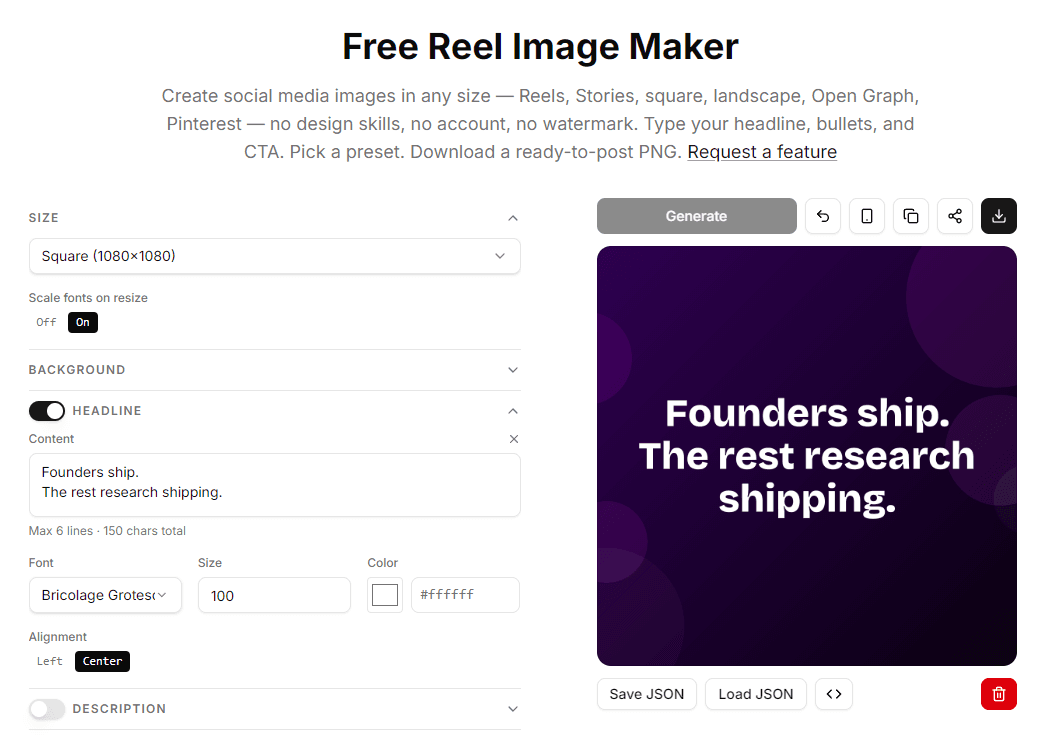
So one app's output became the next app's input. Founder Fortune Cookie wrote the lines. Reel Image Maker turned each line into a card I could post to Instagram and TikTok. Two weeks of written posts became two weeks of written posts plus a stack of images, and the only manual step left was choosing which gradient I liked.
If you scrolled past the two screenshots above without noticing: the line sitting in the Post or No box and the line on that purple card are both real fortunes from the cookie's source code. The screenshots aren't staged for the article. They're the loop I'm describing, caught mid-run.
That's the compounding part nobody tells you about building small things. You set out to make one tiny toy, and you walk away with the toy, plus a week of text posts, plus the images those posts become in a second app you already owned, plus a screenshot people share. One two-hour decision, several months of distribution across every platform I post on.
This article is the next link in that chain. I shipped the apps, lined up the posts, and somewhere in the middle of it thought — wait, this is a decent story. So I did the exact thing I keep telling you to do. I turned it into the post you're reading right now, for everyone still thinking instead of building.
The move is to build the small idea, not to keep refining the post
Here's what I keep relearning. The distance between "I've been saying this for two weeks" and "I built the thing that says it for me" was two hours of work I almost didn't do, because it felt too small to matter. Most of my best-traveled work started out feeling too small to matter.
Automator began as a three-week prototype and has since published over 200,000 music releases on near-total autopilot. None of that was visible from the planning doc. It was only visible after the thing existed and started telling me what it wanted to become.
A post is an opinion. An app is the same opinion, made playable, screenshot-able, and shareable, running 24/7 without you in the room. If you're a builder, your content advantage isn't writing more posts about what you think. It's shipping the smallest possible version of what you think and letting people touch it — then letting your own tools feed each other.
So if you've been circling an idea — posting around it, talking about it, refining the wording — that's the signal you already understand it well enough to build the two-hour version. Stop sharpening the post. Build the thing the post is about. You won't know what it opens until it exists, and the ones you abandon at the idea stage open nothing at all.
I didn't expect a two-hour toy to become a content engine, and I definitely didn't expect one app to start writing copy that a second app turns into images. Both happened because I built the small thing instead of posting about it one more time.
Building the smallest version of an idea — and shipping it in weeks, not months — is most of what I do for founders. If you've got something you keep talking about but haven't built, see the MVP Development service page or book a call.