
Dubai Rent: Cheques, Deposits & Fees Nobody Warns You About
- •
- 9 min
- •
- RSS

Forward Deployed Engineer · Dubai
In Dubai, you don't pay rent monthly. You hand your landlord a stack of post-dated cheques — physical ones — on the day you sign the lease, and each one is cashed on its own due date across the year. The number of cheques is negotiable: 1, 2, 4, 6, or 12. Fewer cheques usually means lower total rent but more cash upfront — sometimes the entire year in a single cheque.
That one fact catches almost everyone off guard. "Wait — I pay my whole year's rent at once? In one cheque?" Not necessarily. But possibly. And it's only the start: on top of the rent itself you owe broker commission, a security deposit, DEWA and Ejari registration, and a municipality housing fee — most of it due before you get the keys.
This isn't a minor administrative detail. The cheque structure is the single biggest factor in how much cash you need before you move, how your cash flow behaves all year, and whether you'll hit months where your bank balance takes a serious hit.
This guide covers the Dubai rental system as of 2026, including typical fees, deposits, and payment structures. For a personalized calculation based on your rent and payment schedule, try the free Dubai Budget Planner.
| Upfront cost | Typical amount |
|---|---|
| Broker commission | 5% of annual rent |
| Security deposit | 5% of annual rent (apartments) |
| DEWA deposit | AED 2,000 |
| Ejari registration | AED 230–300 |
| Municipality housing fee | 5% of annual rent/year (via DEWA bill) |
| Chiller fees | AED 500–1,500/month (where applicable) |
How cheques actually work
In most countries, rent is a monthly direct debit. You set it up once and forget about it. In Dubai, the process is fundamentally different.
When you sign a lease, you agree on two things: the annual rent and the number of cheques. You then write post-dated cheques — physical ones — for each payment, and hand them all to your landlord on the day you sign. The landlord deposits each cheque on its due date throughout the year.
Here's what that looks like in practice for an AED 80,000/year apartment:
- 1 cheque: You hand over one cheque for AED 80,000. The landlord deposits it immediately. You've paid the entire year upfront.
- 2 cheques: Two cheques of AED 40,000 each — one deposited now, one six months later.
- 4 cheques: Four cheques of AED 20,000 — deposited quarterly.
- 6 cheques: Six cheques of approximately AED 13,333 — deposited every two months.
- 12 cheques: Twelve cheques of approximately AED 6,667 — closest to a monthly payment, but still via cheque.
The critical detail: fewer cheques typically mean lower total rent. A landlord who accepts 1 cheque might charge AED 75,000 for the same apartment that costs AED 85,000 with 12 cheques. The landlord gets the money faster and with less administrative overhead, so they discount accordingly.
This creates a genuine financial trade-off that doesn't exist in other countries. You're choosing between a lower annual cost (fewer cheques, more cash upfront) and better cash flow management (more cheques, higher annual total).
| 1 cheque | 4 cheques | 12 cheques |
|---|---|---|
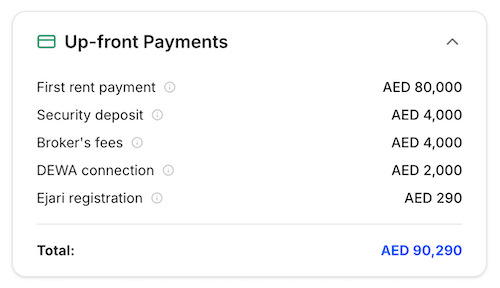 | 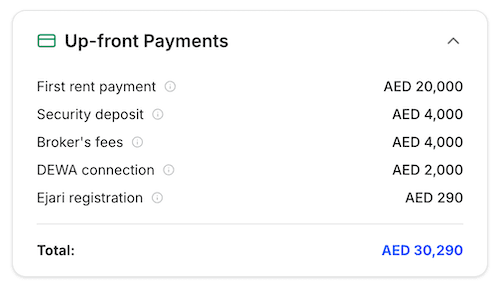 | 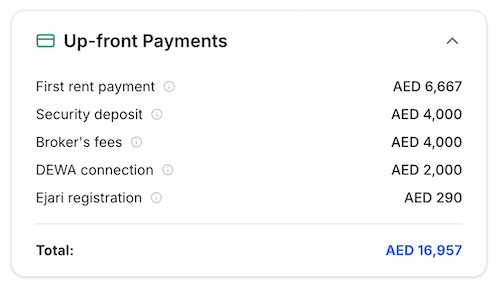 |
The fees that stack on top of rent
The annual rent is the headline number, but it's not the only cost associated with renting in Dubai. Several additional fees land during the lease signing process:
Broker commission
If you used a real estate agent — and as a newcomer, you almost certainly will — they charge a commission. The industry standard is 5% of the annual rent.
On an AED 80,000 apartment: AED 4,000. On an AED 120,000 family apartment: AED 6,000.
This is a one-time cost when you sign, non-refundable. Some agents negotiate, some charge a flat fee, but 5% is what you should budget for.
Security deposit
Landlords require a refundable security deposit — typically 5% of the annual rent for apartments, 10% for villas. This is returned when you vacate, minus any deductions for damage beyond normal wear and tear.
On an AED 80,000 apartment: AED 4,000 held for the duration of your tenancy.
Ejari registration
Ejari is the Dubai Land Department's tenancy registration system. Every rental contract must be registered with Ejari. The fee is approximately AED 230–300 for online registration through the Dubai REST app, or slightly more through a typing center.
This registration isn't optional — it's legally required. Without Ejari, you can't set up DEWA, can't get a parking permit, and can't sponsor dependents.
DEWA deposit
When you activate your electricity and water account, DEWA requires a refundable security deposit — typically AED 2,000 for apartments and AED 4,000 for villas. This is separate from your landlord's security deposit and is returned when you close your DEWA account.
It's one more upfront cost that doesn't appear in any rental listing.
Chiller fees (district cooling)
In many newer buildings — particularly in areas like JLT, Dubai Marina, and Business Bay — air conditioning isn't included in your DEWA bill. Instead, cooling is provided by a district chiller company (Empower, Emicool, or similar) and billed separately. This can add AED 500–1,500 per month depending on the size of your apartment and usage.
Before signing a lease, ask whether the building uses district cooling and check with the chiller company for typical monthly costs. This is one of the most common budget surprises for newcomers.
The housing fee most people miss
Here's the one that catches the most people off guard: the Dubai Municipality Housing Fee.
Every tenant in Dubai pays 5% of their annual rent as a housing fee. This isn't collected by your landlord — it's divided into 12 monthly installments and added to your DEWA (electricity and water) bill.
On an AED 80,000 apartment, that's AED 4,000 per year, or AED 333 per month added to your utility bill. On an AED 120,000 apartment, it's AED 6,000 per year, or AED 500 per month.
When people say "my DEWA bill is surprisingly high," this is usually why. The actual electricity and water usage might be AED 400–600, but the housing fee pushes the total bill to AED 700–1,100. It's printed as a separate line item on the bill, but most newcomers don't know to look for it.
The annual rent cycle
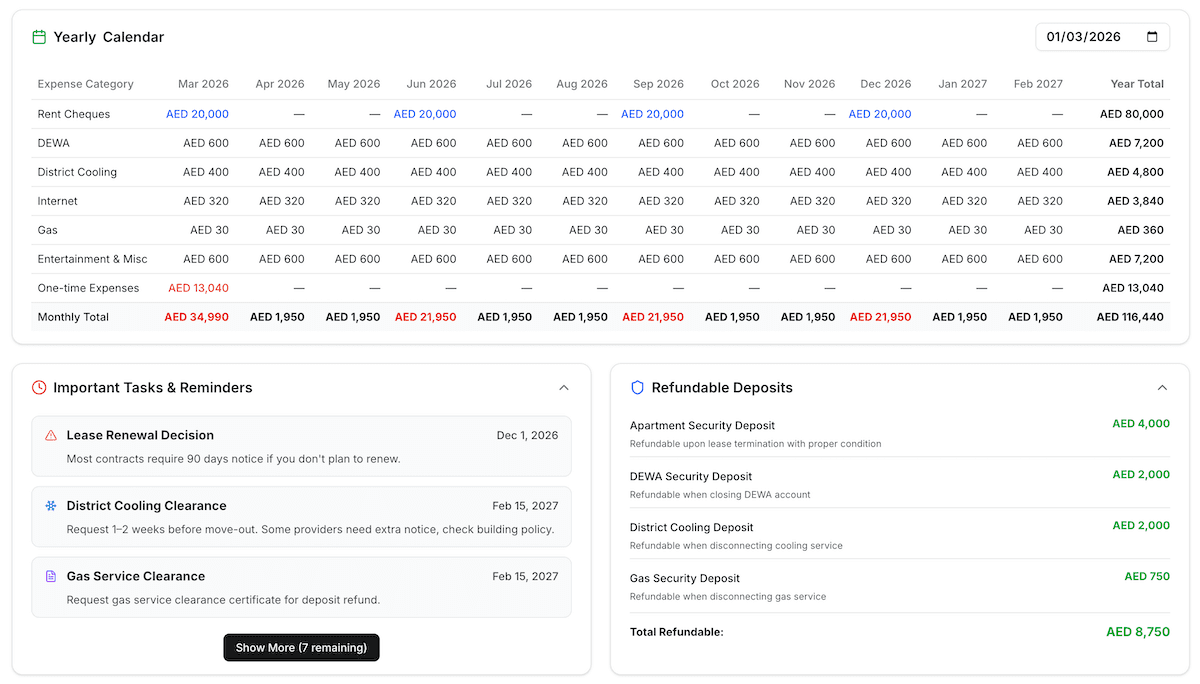
Understanding the cheque system is essential for cash flow planning. Unlike monthly rent, where expenses are evenly distributed, Dubai's system creates predictable but significant payment spikes.
The cash flow problem
Consider a couple paying AED 100,000/year in 4 cheques. Their monthly income is AED 20,000. In most months, their expenses are manageable — utilities, transport, food, extras. But four times a year, they need to produce AED 25,000 in a single payment. That's more than an entire month's salary, dedicated to one cheque.
If they haven't planned for it, those cheque months become genuinely stressful. And a bounced cheque in Dubai isn't just an inconvenience — it carries fines, potential bank penalties, and can result in civil legal action from your landlord.
Planning for payment spikes
The people who manage this well do something specific: they divide their annual rent by 12 and set that amount aside every month, regardless of when the cheques are due. If rent is AED 100,000/year, they save AED 8,333 per month into a dedicated account. When cheque day comes, the money is already there.
This is exactly the kind of planning that a yearly cash flow calendar makes visible. When you can see which months have cheque payments and which don't, you can plan your savings accordingly.
Rent negotiation: what most newcomers don't know
Several aspects of Dubai rent are negotiable, but newcomers rarely negotiate because they don't know they can:
Number of cheques
Landlords prefer fewer cheques. If you can pay in 1–2 cheques instead of 4–6, you're in a stronger position to negotiate a lower total rent. The discount can be meaningful — AED 5,000–10,000 off the annual rent for a 1-cheque deal versus a 4-cheque deal is common.
Rent start date
If the apartment is currently vacant, you can often negotiate a later start date or a few weeks of free rent. Landlords with empty units are paying maintenance fees and service charges on an apartment generating no income. A quick move-in is valuable to them.
Contract length
Standard leases are 12 months, but some landlords will offer a discount for a 2-year commitment. If you're certain about staying, this can save money.
Included maintenance
Some landlords will include minor maintenance (AC servicing, plumbing fixes) in the lease. This is worth asking about, especially for older buildings where these costs tend to be higher.
The real number: what rent actually costs
When someone asks "how much is rent in Dubai?", the honest answer includes more than the headline number. Here's the full first-year cost of an AED 80,000 apartment:
- Annual rent: AED 80,000
- Housing fee (5%): AED 4,000
- Broker commission (5%, first year only): AED 4,000
- Security deposit (5%, refundable): AED 4,000
- DEWA deposit (refundable): AED 2,000
- Ejari registration: AED 300
Total first-year outlay: AED 94,300 (of which AED 6,000 is refundable)
Effective monthly cost: AED 7,358 (excluding refundable deposits — AED 88,300 / 12) — not AED 6,667 as the headline rent suggests.
That's a 10% gap between the advertised rent and the actual recurring cost. And the upfront cash you need before you move in is significantly higher than the rent alone. For a larger apartment at AED 150,000/year, the effective monthly cost is AED 13,775 versus the AED 12,500 you'd calculate from the headline number.
Understanding this gap before you start looking at apartments — before you fall in love with a place that's technically AED 2,000/month outside your budget — is the difference between comfortable living and monthly stress.
Plan before you search
The most common mistake newcomers make with Dubai rent isn't choosing the wrong apartment. It's starting the search without understanding the true cost structure. By the time they've found a place they love, they're emotionally committed and only then discover the deposits, fees, and housing fee that push the total beyond their budget.
The Dubai Budget Planner exists specifically for this moment — before you start looking. Enter your income, choose your target rent level, and see the full picture: every up-front cost, every monthly expense, and a 12-month calendar showing when payments fall due. Choose a template that matches your situation and you'll have a realistic number in minutes.
Know your number first. Then start your search.