
I Built a Free Dubai Budget Planner Because We Kept Getting the First Month Wrong
- •
- 4 min
- •
- RSS

Forward Deployed Engineer · Dubai
Three apartment moves in Dubai. Three times we knew exactly what the contract said, and three times the full upfront number was still higher than we'd planned.
Not dramatically higher — but a few thousand dirhams of "wait, that fee again" adds up fast when you're also writing post-dated cheques for a full year's rent and handing over a security deposit on the same afternoon.
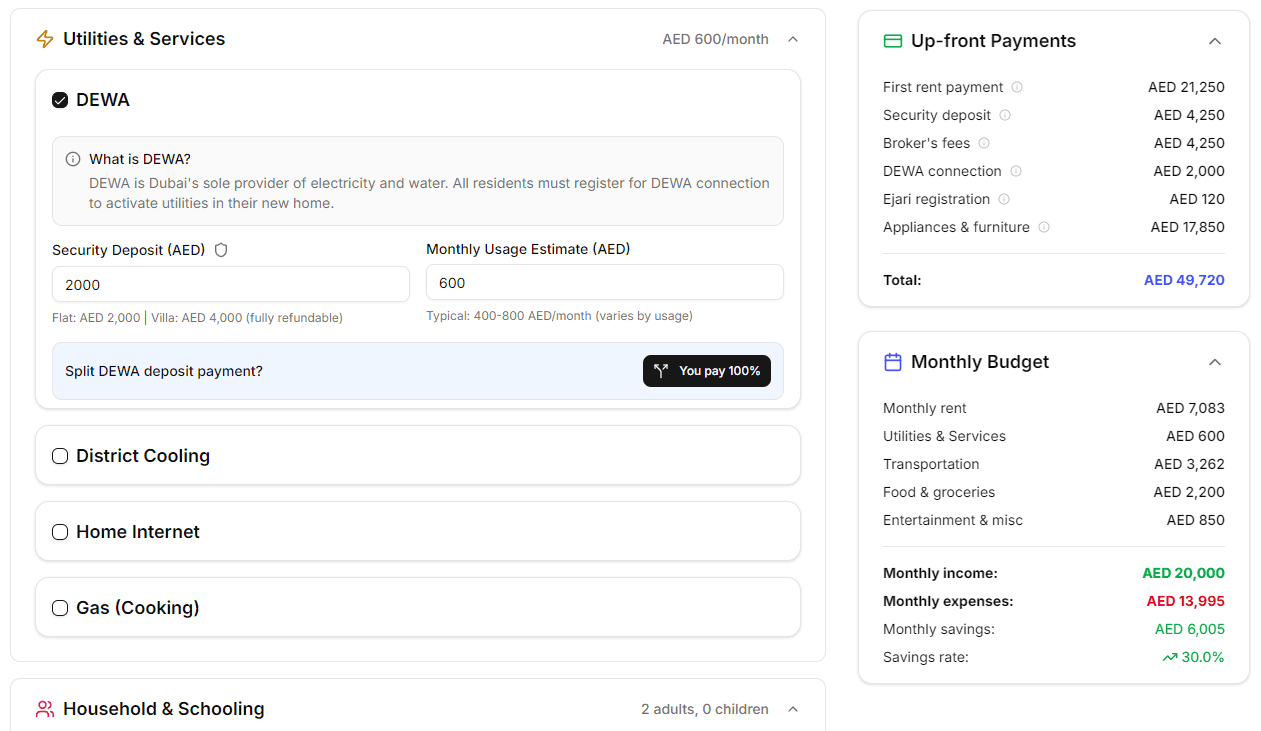
The annual rent figure on the contract is where the accounting starts. Add the security deposit — five percent of annual rent for unfurnished properties, ten percent for furnished ones. Add broker commission, usually another five percent. Add the DEWA deposit (AED 2,000 for a flat, AED 4,000 for a villa), the connection and activation fee, the Ejari registration. If the apartment doesn't come with a kitchen — many don't — add appliances. If the building uses district cooling, add that deposit. If it uses gas, add the pipe connection fee and its own deposit.
Before our fourth move, I stopped improvising and built a calculator.
What it covers
Dubai Budget Planner takes your rent, your cheque arrangement, and your household setup, and returns two numbers: what you'll spend before you get the keys, and what you'll spend every month after.
The upfront total covers rent split across however many cheques you're offering, security deposit, broker commission, Ejari registration with three channel options because the fee actually differs (AED 120 online, AED 215 at a service center, AED 290 at a typing center), DEWA connection and activation, district cooling and gas deposits where applicable, appliances for unfurnished apartments, moving company costs, and for people arriving from abroad, international flights, temporary hotel stay, and visa medicals.
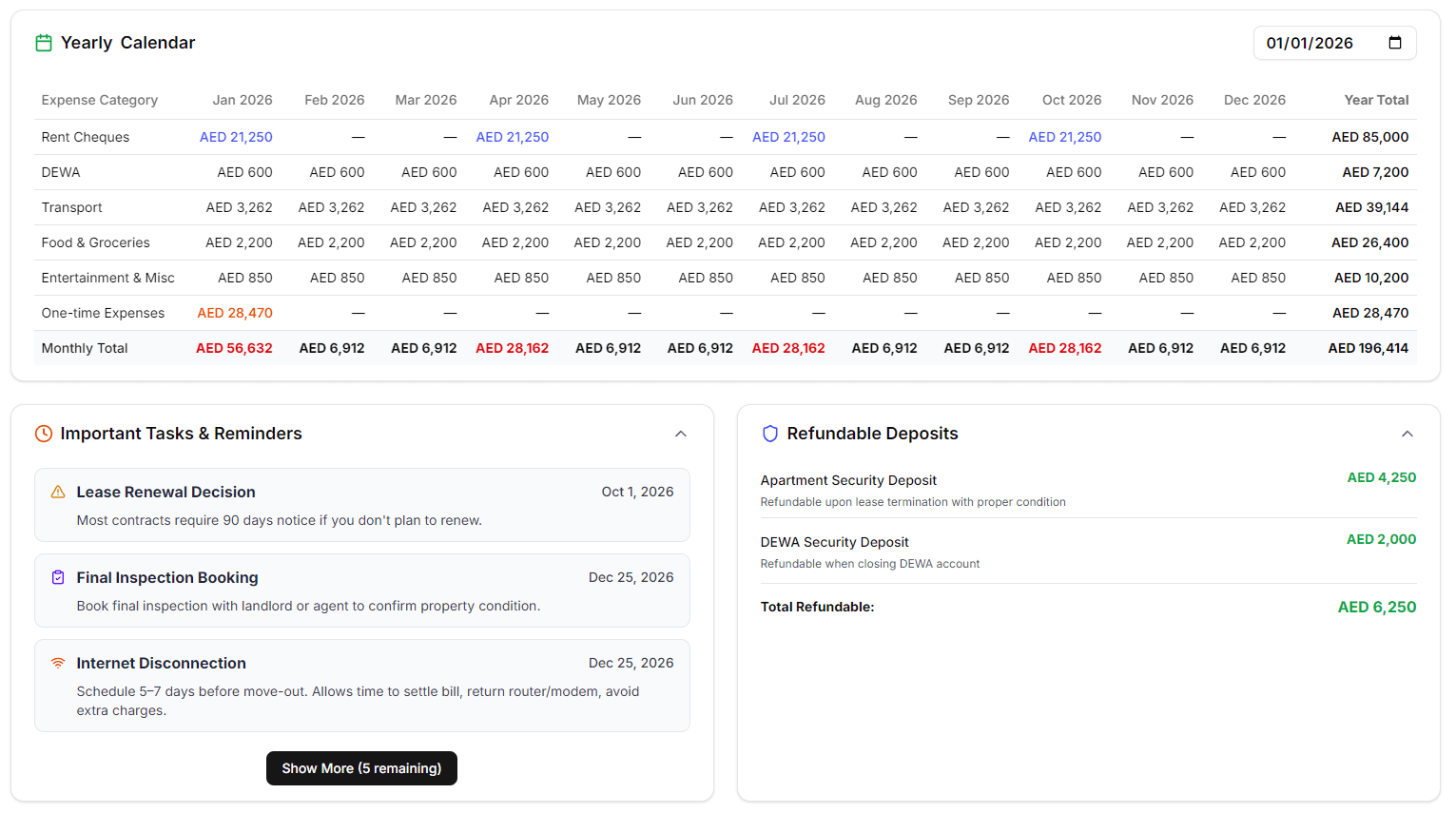
The monthly total covers rent installments, utilities, transport, food scaled to household size, and schooling. The school fees use age-based ranges because a nine-month-old in nursery (AED 1,500–3,000/month) and a fourteen-year-old in secondary school (AED 3,000–6,000/month) are completely different budget lines. The number of children matters less than how old they are.
There's also a refundable deposits widget — a running total of everything you'll get back when you leave. DEWA deposit comes back. Security deposit comes back, minus deductions. Broker commission doesn't. Knowing that before you sign helps you think about your exit before you've finished moving in.
Everything recalculates in real time.
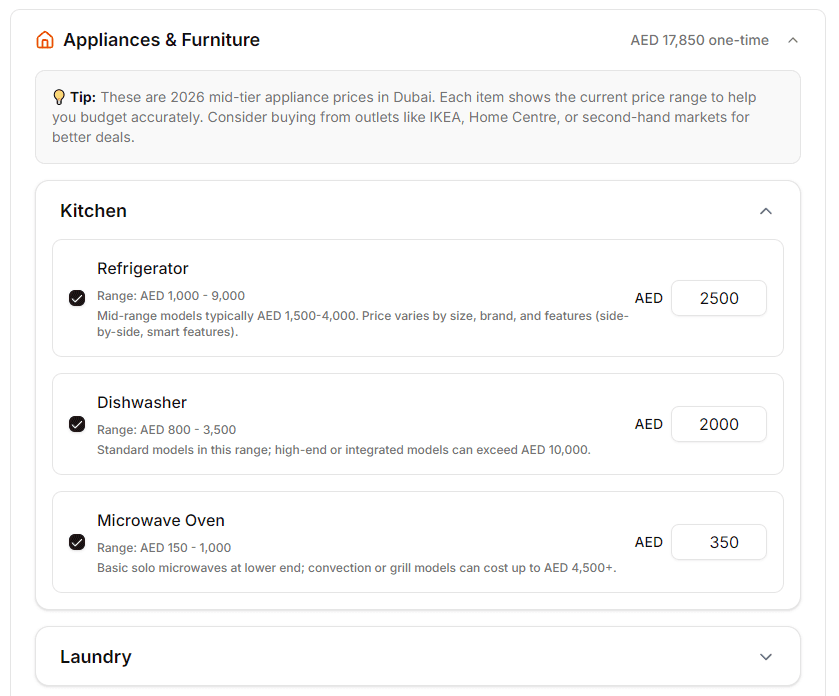
If you're moving into an unfurnished apartment — which most long-term renters in Dubai do — the appliances section deserves a close look. The planner lists 2026 mid-tier prices by item (refrigerator, washing machine, dishwasher, microwave, and more), each with a price range and an editable field so you can swap in your own numbers. Buying second-hand from Facebook Marketplace or Dubizzle can cut this line by half; the default figures assume new from Home Centre or similar.
The cheque count changes more than just the cash requirement
The number of cheques you can offer restructures the entire apartment search — not just how much you need upfront.
In Dubai, rent is paid by post-dated cheque. You hand the landlord one to twelve cheques at signing, each covering a portion of the year. Landlords who accept twelve cheques are taking on payment risk across twelve separate transactions. Many won't, especially in areas where demand is strong. If you need twelve cheques and the apartment you want requires four, that's not a negotiation — it's a filter you already didn't pass before the conversation started.
Modeling this before you shortlist anything changes what's actually in range. The same AED 120,000 apartment might cost AED 3,000–5,000 more annually if you're paying in twelve cheques rather than two, and often significantly more in upfront cash depending on what chunk of the year each cheque covers. The detailed mechanics of the system are covered elsewhere — but once you understand the rules, the calculator handles the arithmetic.
Who uses it
People arriving in Dubai for the first time, trying to get an honest number before committing to anything.
People already here, moving apartments — who want a faster version of the spreadsheet they'd otherwise build themselves.
HR teams managing relocation. The planner includes a sponsorship split so you can track what the company covers versus what the employee pays. Useful when you're budgeting a hire before you've made the offer.
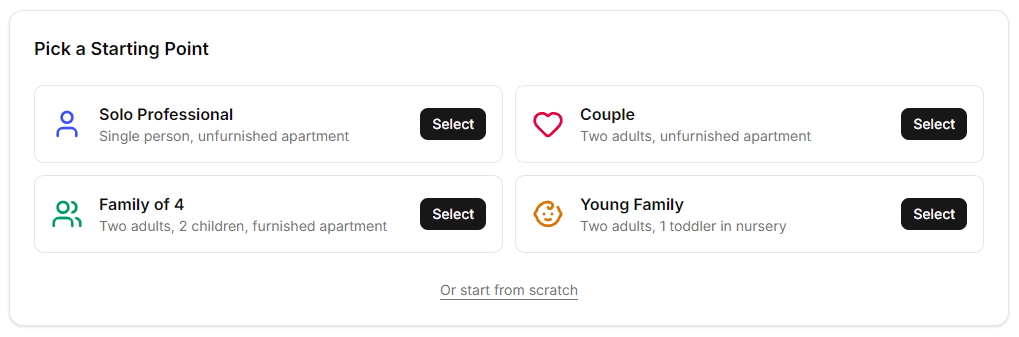
Four templates cover the common household setups: Solo Professional, Couple, Family of 4, Young Family. Start from one and adjust. The full configuration is captured in the URL, so you can share a calculation with a partner or bookmark a setup without creating an account.
There is no account. Dubai Budget Planner is free and lives here.
If your business has a similar gap — relocation tracking, compliance calendars, budget planning across a team — that's the kind of tool I build. See the Internal Tools service page or book a call.