
I Built a UAE HR Compliance Tool. The Market Already Had an Answer.
- •
- 4 min
- •
- RSS

Forward Deployed Engineer · Dubai
A yoga studio in Dubai got hit with fines because their accountant stopped checking their phone. Expired visas, missed renewal deadlines — the kind of thing you find out about when it's already too late to avoid the penalties.
I saw the situation close-up and the question seemed obvious: why doesn't a simple tool exist for this? Government portals are fragmented across freezones. Documents live in email threads and WhatsApp groups. Nobody owns the calendar. It looked like a coordination problem waiting to be solved.
So I built something to find out if that was actually true.
What I built to test the idea
TinyHR is a working demo: an expiry dashboard across visas, Emirates IDs, passports, insurance, and contracts; configurable reminders at 60/30/7 days before deadline; task assignment to owner, assistant, or PRO; a document vault; ICS calendar feeds for Google Calendar and Outlook. UAE-specific fields throughout — visa holder vs. remote, emirate, probation end dates.
Two evenings. That's how long the prototype took.
That's the part worth paying attention to. With LLMs in the loop, building a working prototype is no longer the bottleneck — the bottleneck moved to asking the right people the right questions. If a prototype costs two evenings, the validation conversation is the expensive part. Which means you should spend those two evenings and then immediately go talk to people, before you spend two months building something production-ready.
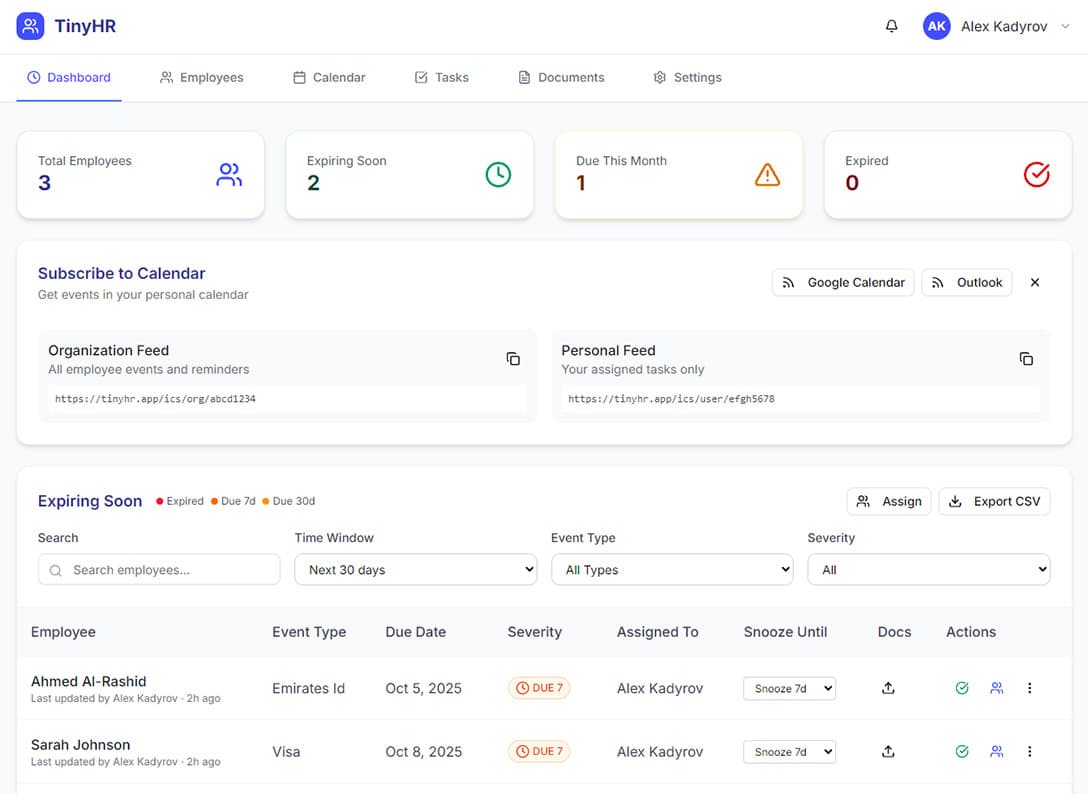
I built it as an experiment to test an idea, not to deploy. The question was whether the problem it solved was real and common enough to justify building further.
What I asked, and who I asked
I spent time asking business owners, LinkedIn contacts, and people running companies in Dubai. Not a survey. Direct conversations: how do you track employee visa renewals, what happens when something's about to expire, has anything slipped through?
The same picture came back from almost everyone.
The market already had two working answers
The UAE has a clear two-track structure for this problem.
Track one: self-managed. Companies that handle their own compliance use government portals directly — AXS, DMCC, RAKEZ, ICP, depending on their freezone. Those portals send renewal reminders. The companies on this track are organized enough to receive and act on them. No gap.
Track two: PRO services. The majority of small UAE businesses use a PRO officer or a PRO service company. PROs handle the entire renewal cycle end to end. The value proposition is "you don't think about this at all." There's nothing to coordinate because someone else is already doing it.
Neither track had the problem I was trying to solve.
There's also a structural technical constraint I hadn't mapped before building: none of the government portals expose APIs. No way to pull data automatically. Any tool you build requires manual data entry — which is the same work, just in a different place. That kills the coordination argument entirely.
The incident wasn't a tooling problem
The original case — the yoga studio fines — looked like a tooling problem from the outside.
It wasn't. The accountant wasn't checking their phone. They wouldn't have checked TinyHR either.
The real problem was organizational: one person owned a critical responsibility with no backup, no check-in, and nobody noticing until it was already too late. Better hire, monthly check-in, shared calendar — any of those would have fixed it. A new tool with the same ownership structure would have failed the same way.
That distinction matters more than it sounds. It's the difference between the problem is widespread and the tooling is missing (build something) and the problem is specific and the root cause isn't tooling (don't).
The model was wrong. That makes it a complete experiment.
I've been here before. CheckMVP was an AI startup validation tool I built, ran on 500+ founder ideas, and then discontinued after concluding that early LLMs were too agreeable to produce honest validation signal. Founders were getting reports that validated their ideas rather than challenged them. The model of how the tool would work was wrong. The right move was to stop.
TinyHR followed the same pattern. The model was: small UAE businesses are managing compliance manually and have no good solution. The validation showed: they're not managing it manually at all — they've either outsourced it or they're using portals that already work.
Stopping isn't the same as failing. The experiment answered the question it was asking. That's what experiments are for.
Not every build needs to become a product. Some need to become a clear no.
Why the demo is still up
It's a working artifact showing UAE compliance domain knowledge and the ability to build this category of internal operations tool. If you're building something in a similar space — or your business has a compliance coordination problem that genuinely sits outside what PRO services and government portals already cover — the demo gives you something concrete to look at.
But it's a demo, not a product. The validation is done.
If you're building something and you're not sure whether the problem you're solving is real, widespread, or already solved by something else — that's worth checking before writing code. See the Founder Consultation service or book a call.