
AI Solutions for UAE Businesses: What Actually Ships (and What Stays a Demo)
- •
- 11 min
- •
- RSS

Forward Deployed Engineer · Dubai
Once or twice a month — over coffee in Dubai or on a virtual call — I meet a business owner, CTO, or consultant who was shown an AI demo that blew their mind. At least one of those conversations ends the same way a few months later: the project they commissioned after that demo never made it to production. Three months. USD 40,000. Nothing running.
The gap between what a demo can do and what a production system must do is where most AI projects stall.
This piece is a practical map of that gap, written for UAE business owners and team leads who are evaluating AI projects in 2026. It covers what actually ships, where projects fail, and how to scope AI work so you end up with a running system instead of a polished presentation.
The gap between demo and production
A demo is a controlled environment. The consultant picks the inputs. The model answers on cue. Nothing is integrated with your real data, your real users, or your real constraints. When the demo works, it's showing you the best case.
Production is the uncontrolled case. Your real data is messier than the demo data. Your users ask questions the demo never anticipated. Rate limits, downtime, unexpected costs, weird edge cases, privacy concerns, compliance requirements — all appear only after the system is live.
The failure mode is predictable: you see the demo, commit to the project, the consultant builds something that works on curated inputs, and then it collapses the first week real users hit it. You're left with a system nobody trusts and a bill that's already been paid.
Know what the gap looks like. Scope for it explicitly.
What ships vs. what doesn't
Here's the pattern I see in UAE companies that actually deploy AI successfully:
What ships reliably
- Document classification and extraction. Invoice processing, contract clause extraction, CV screening, insurance claim intake. These are well-understood problems with mature tooling (OCR + LLM + structured output). Accuracy is predictable (85–98% depending on document quality), cost per document is cents, integration with existing systems is straightforward.
- Conversational AI for narrow, well-defined tasks. Customer support chatbots with a clear knowledge base (FAQs, policies, procedures). Booking bots that complete a single specific workflow (appointment, reservation, ticket purchase). These work because the scope is constrained and the knowledge base is authoritative.
- Structured generation from structured input. Writing product descriptions from SKU attributes. Drafting email responses from templates. Generating report summaries from dashboards. When you give AI structured inputs and ask for structured outputs, results are reliable.
- Semantic search and retrieval. "Find me similar contracts" or "find documents that discuss X topic" — AI-powered search over your own document corpus. Mature, practical, high ROI for knowledge-heavy businesses (law, consulting, medical).
What usually doesn't ship (in 2026)
- Open-ended conversational AI for complex domains. The consultant promises a chatbot that can "answer any customer question." In production, it confidently invents answers to things it doesn't know. This fails.
- Fully autonomous agents for critical business processes. The pitch is "the AI handles everything end-to-end." The reality is you need a human in the loop for consequential decisions, and the system that pretends otherwise is building risk.
- AI-generated content as the primary business output. Customers increasingly detect and devalue it. If your business model depends on content, AI-generation as the headline feature rarely succeeds.
- "Custom-trained models on our data" when your data is small. Most UAE SMBs don't have enough proprietary data to justify fine-tuning. A well-prompted standard model with RAG over your data almost always outperforms a custom-trained one at a fraction of the cost and timeline.
The honest cost picture
AI project costs break into four buckets. Proposals typically focus on development — worth asking about all four upfront:
1. Development
Building the thing. Market rates in 2026:
| Scope | Cost (USD) | Timeline |
|---|---|---|
| Single AI capability (one chatbot, one document processor) | $5,000–$20,000 | 2–6 weeks |
| Multi-feature AI product (2–4 capabilities integrated) | $25,000–$100,000 | 6–16 weeks |
| Enterprise AI (multiple systems, SLAs, monitoring) | $100,000–$400,000+ | 3–9 months |
Where you land depends on who you hire. A senior independent developer works at the low end. A full-service agency — project managers, designers, QA, account management — runs toward the upper end for the same functional scope. Agencies bring project management structure and dedicated QA, which has real value for larger engagements. Understanding what's included helps you evaluate whether the trade-off makes sense for your scope.
Sources: AI Chatbot Development Cost in the UAE 2026, AI Development Cost Dubai 2026, AI Software Development Cost in Dubai
2. Model inference (the ongoing bill)
Every time your AI runs, you pay the model provider. Current prices as of May 2026 (verify on provider pricing pages before budgeting — these change):
| Model | Input / 1M tokens | Output / 1M tokens | Tier |
|---|---|---|---|
| GPT-5.5 (OpenAI) | USD 5.00 | USD 30.00 | Flagship |
| GPT-5.1 (OpenAI) | USD 1.25 | USD 10.00 | Standard |
| GPT-5 Nano (OpenAI) | USD 0.05 | USD 0.40 | Budget |
| Claude Opus 4.7 (Anthropic) | USD 5.00 | USD 25.00 | Flagship |
| Claude Sonnet 4.6 (Anthropic) | USD 3.00 | USD 15.00 | Standard |
| Claude Haiku 4.5 (Anthropic) | USD 1.00 | USD 5.00 | Budget |
| Gemini 2.5 Pro (Google) | USD 1.25 | USD 10.00 | Standard |
| Gemini 2.5 Flash (Google) | USD 0.30 | USD 2.50 | Budget |
Use flagship models (GPT-5.5, Claude Opus 4.7) where accuracy and reasoning quality are critical — complex document analysis, high-stakes decisions, intricate multi-step workflows. Standard models (GPT-5.1, Claude Sonnet 4.6, Gemini 2.5 Pro) cover most business AI tasks well. Budget models (GPT-5 Nano, Claude Haiku 4.5, Gemini 2.5 Flash) are 10–100× cheaper and handle routine work — classification, summarisation, FAQ responses — with acceptable quality. Most production systems route 80% of requests through budget models and escalate only the hard cases to flagship ones.
For typical business workloads — a customer support chatbot handling 500 queries a day — that's roughly USD 5–150/month in model costs depending on which tier you use. For document processing at 1,000 docs/day, it's USD 10–400/month. Must be in your budget.
3. Infrastructure
Hosting, database, vector store, monitoring, logging. Typically USD 50–300/month for small deployments, growing with usage. Managed services (Pinecone, Supabase, Railway) are generally worth the cost over self-hosting until you have real scale.
4. Maintenance
AI systems require ongoing tuning as real-world usage reveals edge cases, as model providers update their APIs, as your data changes. Budget 5–15% of development cost per quarter for maintenance. Pretending this cost doesn't exist is why so many AI projects die within 12 months.
The evaluation questions to ask before you commit
If you're about to sign an AI project proposal, ask these six questions. If the answers aren't clear, the project isn't ready.
- What's the specific business metric this AI improves, and by how much? Not "improves efficiency" — "reduces support ticket resolution time by 30%" or "cuts document processing cost from USD 5 to USD 0.50 per document."
- What happens when the AI is wrong? Every AI system has error modes. If the cost of a wrong answer is high (legal, medical, financial), you need human review in the loop. If the consultant says "our AI doesn't make mistakes," walk away.
- What's the ongoing monthly cost — model, infrastructure, maintenance — after launch? If they can't tell you within a 30% range, they haven't thought about it.
- Where does our data go, and what happens to it? UAE PDPL applies to any business processing personal data. If your AI is calling OpenAI from a server in Ireland, your customer data is crossing borders. This has compliance implications you should understand.
- How will we measure whether the AI is working in production? Dashboards, logs, error monitoring, user feedback mechanisms. If the consultant's answer is "it'll work" without specifying how you'll know, they haven't planned for the gap.
- What's the handoff plan? When the project ends, what do you own? Source code, credentials, model configurations, prompt templates, test datasets, documentation. If any of these stay with the consultant, you'll depend on them for any future changes or migrations.
The "start small, prove value, expand" pattern
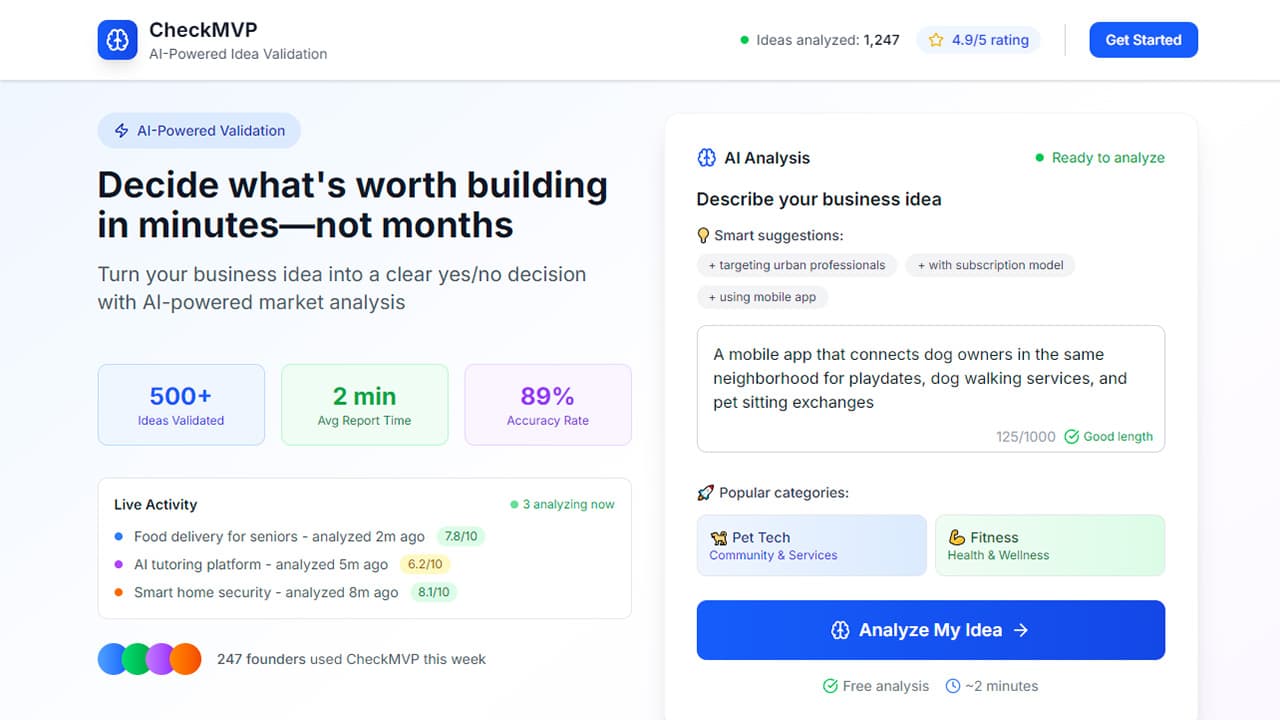
The most instructive example from my own work is CheckMVP — a tool I built to analyze startup ideas and tell founders whether they were worth building.
The scope I shipped first was deliberately narrow: describe your idea in plain text, get one structured LLM report back covering likely buyers, key risks, and next steps. One input. One output. No accounts, no comparison features, no saved history. Built and deployed in two months.
That version ran for six months and processed 500+ ideas. Founders used it, shared reports with co-founders, told me it was helpful. Then I looked at whether any of them made better decisions because of it. The honest answer was no — the AI was generating plausible, agreeable output that validated whatever the founder wanted to hear. It felt like signal. It wasn't.
I shut it down. The lesson wasn't "AI can't help with idea validation" — it's more specific: AI that asks "is this a good idea?" will always find reasons to say yes. The tool was narrow enough to measure, which is why I caught the failure within six months instead of two years. That's the principle in action — start narrow, measure honestly, and be willing to kill it when the measurement tells you something you don't want to hear.
Shutting CheckMVP down sent me toward a completely different approach: away from AI-generated analysis and toward structuring the human conversations that actually produce real validation signal. That's a better-suited tool for a different problem.
The same start-narrow approach shapes how I build the AI features in Made4, an SMM platform I'm currently working on. Brand voice learning, content generation, comment classification — each scoped to one measurable output, validated before the next gets added. CheckMVP is exactly why I build that way now.
The pattern that fails: commissioning a full "AI transformation" that touches every department, takes six months, costs USD 100,000+, and tries to prove its value through a single launch. I've watched those die in staging while a one-feature pilot would have shipped in six weeks and already proved the concept.
Specific UAE context that changes the math
A few things are specific to building AI systems for UAE businesses in 2026:
- Arabic language support is maturing, but benchmark performance still lags English across all major providers. Published evaluations consistently show higher error rates in Arabic compared to English on extraction, classification, and generation tasks. If Arabic is a core requirement, build in extra testing cycles and keep human review in the loop on consequential outputs until you've validated accuracy on your own data — don't assume English benchmark numbers transfer.
- PDPL compliance is a real constraint. Customer data leaving the UAE in API calls to OpenAI needs a legal basis and appropriate safeguards. Azure OpenAI in UAE data residency regions, or running open-weight models locally, are valid alternatives.
- UAE data infrastructure is real and usable. AWS Middle East (Bahrain), Azure UAE North, and Core42 (G42's cloud arm) can all support production AI workloads. You can deploy entirely within the UAE if compliance or latency requires it — costs run ~20–30% higher than Ireland or US regions. As with any single-region deployment, build redundancy in from the start rather than retrofitting it later.
- The UAE AI ecosystem is richer than most people realize. G42, Presight (listed on ADX, focused on analytics and intelligence), and the Jais open-weight Arabic LLM (built by G42's Inception, MBZUAI, and Cerebras — now at 70B parameters) are all worth evaluating if your project requires Arabic language support or UAE-sovereign data handling.
When to not do AI at all
The hardest thing to hear, but often the right answer: AI isn't the solution to most business problems.
- If your process is broken, AI will speed up the broken process. Fix the process first.
- If you don't have clean data, AI will learn from dirty data. Fix the data first.
- If your users don't trust you to handle their information, AI will make them trust you less. Fix the trust first.
- If the problem is a people problem, AI can't solve it. Fix the management or hiring first.
A consultant worth working with will tell you this upfront — sometimes the most useful answer is "not yet" or "fix this first."
The projects that actually work look the same
Every AI project I've delivered that stayed in production shares the same shape: a scope narrow enough to measure, data bounded enough to be authoritative, a human confirming the consequential calls, and a handoff where the client owns everything — code, credentials, prompts, documentation.
Every AI project I've watched get cancelled shares a different shape: scoped to impress, not to prove; too wide to validate; dead in staging when the demo assumptions collided with real users.
The difference between those two outcomes is whether the project was designed to answer a specific question or to look like transformation.
Start narrow. Prove value. Expand from there.
For how I scope and deliver AI engagements — from discovery audit through production deploy — see the AI Solutions service page.