
MVP Development in Dubai: What Founders Actually Need (and What They Don't)
- •
- 12 min
- •
- RSS

Forward Deployed Engineer · Dubai
The first MVP I ever shipped had 47 features. The users only cared about 3 of them.
That was a painful discovery — and the starting point for how I think about MVPs now. Across 30+ products I've built since, the same pattern has repeated enough times that I stopped treating it as a surprise. An MVP isn't "a small version of your final product." It's a specific experiment, designed to answer a specific question, built with the minimum code that can honestly answer it. Everything else is noise.
In Dubai in 2026, I see the same pattern repeatedly: founders arrive with a spec document listing every feature they can imagine, ask for a quote, and get shocked when the realistic answer is USD 50,000–150,000 and 4–6 months. Then they cut their budget in half, cut their timeline in half, and ship something that still doesn't answer the question they needed answered.
This piece is about how to actually scope, build, and ship a useful MVP — and what to stop pretending about.
If you're budgeting for an MVP specifically, the Dubai Budget Planner isn't the right tool — it's for cost-of-living. But the thinking is the same: know the full picture before you start.
What an MVP actually is
The working definition I use:
An MVP is the smallest thing you can put in front of real users that answers one specific question about whether your business idea works.
Three parts, all load-bearing:
- "The smallest thing" — scope discipline. Every feature you cut saves time, money, and — more importantly — reduces the surface area of things that can go wrong.
- "Real users" — not friends, not investors, not your mom. People who would actually use this product if it existed, ideally ones who would pay for it.
- "One specific question" — you're testing a hypothesis. "Will people pay for this?" is a specific question. "Will this be a successful business?" is too vague to test.
If you can't state, in one sentence, the question your MVP is trying to answer — you don't have an MVP plan, you have a feature list.
The question types most MVPs actually answer
Most startup questions reduce to one of four:
1. "Do people want this at all?"
The simplest question, and usually the one founders skip. You don't need a functional product to answer it. You need a landing page, a plain description of what you're offering, and a signup form. If nobody signs up, you've answered the question cheaply.
This is the "smoke test" MVP. Cost: USD 200–1,000. Timeline: 1–5 days.
2. "Will people do the thing?"
Beyond intent, do people actually take action? Upload the file, invite a teammate, fill in the calendar, make the first purchase? This requires a working product, but only the specific flow you're testing.
This is the "minimum functional" MVP. Cost: USD 1,500–6,000. Timeline: 1–3 weeks.
3. "Will people pay for this?"
You need an actual product, actual payment, and actual value delivery. Not a lot of features — but the ones you build must work end-to-end.
This is the "charge real money" MVP. Cost: USD 5,000–20,000. Timeline: 2–5 weeks.
4. "Does this solve the problem at scale?"
Now you need to handle real load, edge cases, integrations, and support. This isn't really an MVP — it's a v1 product. Most founders mistake this for MVP scope, which is why their MVPs take a year.
This is the "early product" MVP. Cost: USD 20,000–60,000+. Timeline: 2–5 months.
Match your question to the right level. Most founders reach for level 4 when level 2 would have answered the same question for 10% of the cost.
Before you pick a level, pick the right question. The failure mode I've seen most often: founders ask "will people want this?" and collect enthusiastic answers they treat as validation. They aren't.
The more useful frame: what's the biggest reason this might not work? Design the smallest test that would prove that concern wrong — using past behavior, not "would you use this?" responses.
I learned this the hard way from CheckMVP. Six months, 500+ ideas analyzed, founders telling me it was useful. I stopped when I realized the AI was generating agreeable reports, not honest signal — validating enthusiasm instead of challenging the core assumption. The product wasn't wrong in execution. The question it was answering was wrong. That distinction costs you everything if you don't catch it before you build.

What gets cut (and what doesn't)
Every MVP makes trade-offs. Here's my default:
Cut aggressively
- User management beyond basic auth. Email + password or magic link. No SSO, no multi-tenancy, no role hierarchies unless your core test requires them.
- Admin panels. You can query the database directly for the first 50 users. Build admin UIs when the count is painful.
- Settings pages. Most "user preferences" don't get used. Ship with opinionated defaults.
- Email notifications beyond onboarding and password reset. Add them as users request them, not preemptively.
- Mobile apps if the web works. A responsive web app is 10× cheaper than a React Native app, and most early users will use web anyway.
- Analytics dashboards. Use Clarity, Google Analytics, and Mixpanel's free tier. Don't build charts in-product until you're sure users want them.
- Content management systems. Edit content in code. It's faster. Add a CMS when non-technical people need to edit content regularly.
Don't cut
- Authentication and authorization done properly. Security shortcuts compound. Spend the time.
- Automated tests for the critical paths. You'll break these features. Tests catch it before your users do.
- Basic error monitoring. Sentry or similar, on day one. When errors happen in production — and they will — you want to know before users tell you.
- Backups and data export. Your database will be the most valuable asset. Back it up. Let users export their own data.
- HTTPS, CSRF protection, rate limiting. Non-negotiable. Not "MVP-level" concerns.
- A clear path to scaling what you've built. Shortcuts that work at 10 users but break at 1,000 are technical debt. Shortcuts that scale cleanly to 1,000 are just good decisions.
The architecture choices that matter at MVP stage
Three decisions that disproportionately shape whether your MVP survives first contact with real users:
Choice 1: database
Default to PostgreSQL. Not "because it's trendy" — because it's the most versatile general-purpose database with the best long-term ergonomics. You can start simple (small managed Postgres on Neon/Supabase/Railway), and it will scale with you for 3–5 years.
The alternatives:
- Firebase/Firestore — fast to start, hard to query later. Fine for chat apps and real-time collaboration. Bad for anything where reporting or analytics matter.
- MongoDB — flexible schema is a trap at MVP stage. You end up with five versions of the same document and no way to enforce consistency.
- Airtable/Notion as backend — for truly minimal MVPs (level 1 from above), yes. For anything beyond that, no.
Choice 2: frontend stack
Default to Next.js + React + TypeScript. Boring, well-documented, easy to hire for, and deploys cleanly to whatever hosting you choose.
The temptation is to reach for something more exotic — Remix, SvelteKit, Astro, Solid. These are all fine technologies. None of them are worth the hiring and ecosystem cost at MVP stage. Pick boring tools. Build interesting products.
Choice 3: hosting and deploy
Option A — Managed services (no DevOps required): Vercel for frontend, Neon/Railway/Supabase for database, Cloudflare R2 or AWS S3 for file storage. About USD 50–150/month at MVP scale. Zero server administration. Right choice if nobody on your team has infrastructure experience.
Option B — Your own VPS (better value, one-time setup cost): A VPS on Hetzner, DigitalOcean, or Contabo runs USD 5–30/month for the same workload — a fraction of managed services. You get full control, no vendor lock-in, and costs that don't scale with traffic. The catch: you need someone to configure it. A one-time DevOps engagement — CI/CD pipeline from GitHub, Nginx, SSL, backups, monitoring — typically takes 1–2 days and costs USD 200–500. After that, deploys are automatic and the server runs itself.
I run everything on my own VPS. For most solo founders without a technical co-founder, Option A is still the pragmatic starting point. But if you're hiring a developer who knows their way around a server, ask them to set up Option B — you'll pay less every month and own the infrastructure outright.
The mistake to avoid either way: provisioning your own Kubernetes cluster "for scalability." You don't have scalability problems at 100 users.
The 4–8 week realistic timeline
A well-scoped level-3 MVP (charge real money) built by a senior team realistically looks like this:
- Week 1: product spec, user flows, tech stack decisions, design system. Nothing in code yet. Decisions, not artifacts.
- Week 2–3: core auth, database schema, primary user flow. Users can sign up, onboard, and use the main feature.
- Week 4–5: payment integration, secondary flows, error handling, monitoring. Users can actually pay.
- Week 6: polish, edge cases, copy, mobile responsiveness.
- Week 7: production deploy, monitoring setup, first 5–10 real users invited.
- Week 8: iterate based on first-user feedback, fix the things that only became obvious in production.
Deviations from this timeline almost always come from scope creep — someone adds a feature "while we're at it." The antidote is a written scope document that both sides agreed to in week 1 and a clear change-order process for additions.
What AI-powered development changes (and what it doesn't)
The 4–8 week timeline above reflects production-grade development. In 2026, with tools like Claude Code, Cursor, and Codex, the execution layer is significantly faster — and the pricing below reflects that. But understanding what actually changed helps you set the right expectations.
What's faster:
- A smoke test landing page that took 2–3 days now takes a few hours.
- A core CRUD feature that took a week now takes 1–2 days.
- Boilerplate — auth setup, database schema, API wiring — used to be 20–30% of a project's time. AI handles most of it now.
- For a tight scope (one user flow, one core feature), a working deployed MVP in a week is realistic. I've done it.
What hasn't changed:
- The discovery and scoping phase. AI can't tell you what to build or whether the problem is real. That thinking still takes the same amount of time — and skipping it costs more than ever when you can ship the wrong thing in four days.
- Architecture decisions. Bad choices compound just as fast whether the code was written in an hour or a week. Senior judgment on what to build and how it fits together is still the most valuable input.
- Security review. AI-generated code needs the same security pass as human-written code — sometimes more careful review, because the generated patterns can be subtly wrong in ways that aren't obvious.
- QA and edge cases. Code that looks right isn't always code that handles real-world inputs correctly. User testing and edge-case handling don't compress well.
The honest implication for timelines: a smoke test MVP that previously took 1–2 weeks can now be done in 1–3 days. A minimum functional MVP that took 3–6 weeks is now more like 1–2 weeks for a focused scope. The savings are real at the execution layer. The thinking, scoping, and validation work in front of it hasn't shortened.
Pricing reality
The honest pricing ranges I see right now:
| MVP tier | Scope | Cost (USD) | Timeline |
|---|---|---|---|
| Validation sprint | Landing page + waitlist + analytics | 500–2,000 | 1–5 days |
| Core MVP | 3–5 core features, auth, database, payment | 5,000–15,000 | 2–4 weeks |
| Full product v1 | 6–10 features, admin panel, integrations, mobile-responsive | 15,000–30,000 | 5–10 weeks |
These ranges reflect AI-assisted development in 2026. A landing page at USD 3,000–5,000 was a reasonable market rate two years ago. Today it isn't — the tooling has moved too far for that price to make sense for either side.
Below these ranges for the Core MVP and above, something is being cut — scope, quality, or both. Ask what.
Above these ranges for true MVP scope, you're either paying for agency overhead (account managers, project managers, design sprints) or the scope isn't actually MVP.
Common mistakes that kill MVPs
- Building for the full target market. Your MVP is for the first 100 users. Design for them, not for everyone.
- Waiting for perfect before launching. Every week of delay is a week of lost learning.
- Not talking to UAE users before building. B2B products aimed at English-speaking founders can often skip localisation research. Consumer products aimed at UAE nationals or Arabic-speaking expats usually can't — their workflows, device habits, and communication patterns are different enough to matter. This isn't a language problem. It's a user research problem. If you haven't talked to your actual target users before scoping, you're guessing.
- Paying for a design system you don't need. shadcn/ui or similar starter components are free and look professional. Custom design systems are premature at MVP stage.
- Not instrumenting for learning. You launched to learn. If you're not tracking what users do, you learn nothing.
- Hiring a freelancer who can't explain trade-offs. If the person you're hiring says yes to everything, they're either junior or overpromising. Senior builders push back on scope.
What you actually own when the MVP ships
This is the checklist I hand to clients at handoff:
- Full source code in a git repository owned by the client.
- Deploy access to all hosting services (domain registrar, hosting platform or VPS, database, file storage).
- Documentation: architecture overview, setup instructions, deploy instructions, common troubleshooting.
- Credentials for every third-party service in a shared password manager.
- A list of every known limitation, edge case, and "we'll need to fix this later" item.
- At least one knowledge-transfer session with whoever will maintain the code.
If an MVP ships without these, it's not done yet — it's a deliverable that the builder can still hold over you. Own everything from day one.
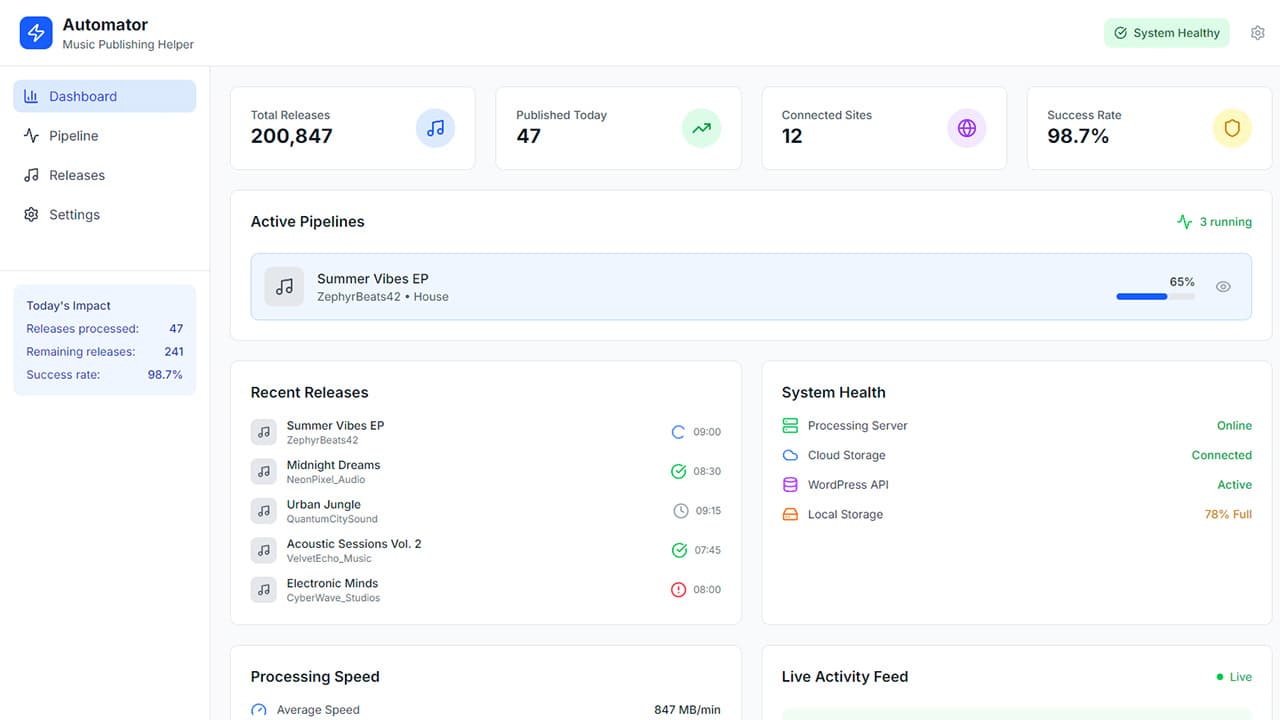
The RealEstateCRM I built in 2021 is still running for its client without my involvement. The Automator — a music publishing pipeline built the same year — just got refactored and now handles 100–150 posts a day across multiple sites. Neither requires me anymore. That's what a proper handoff produces.
Start with the question, not the features
The founders whose MVPs succeed are almost always the ones who can answer "what specific question are we testing?" in a single sentence. The ones whose MVPs fail — in my experience — almost always built a product they liked, launched it, and tried to figure out what question it answered after the fact.
Start with the question. Match it to the right MVP level. Scope ruthlessly, build with production-grade defaults on the basics, and ship when the experiment is ready to run — not when the product is finished. It never will be.
For a structured walkthrough of how I price and deliver MVP engagements — milestone splits, invoicing flow, and deliverables — see the MVP Development service page.